


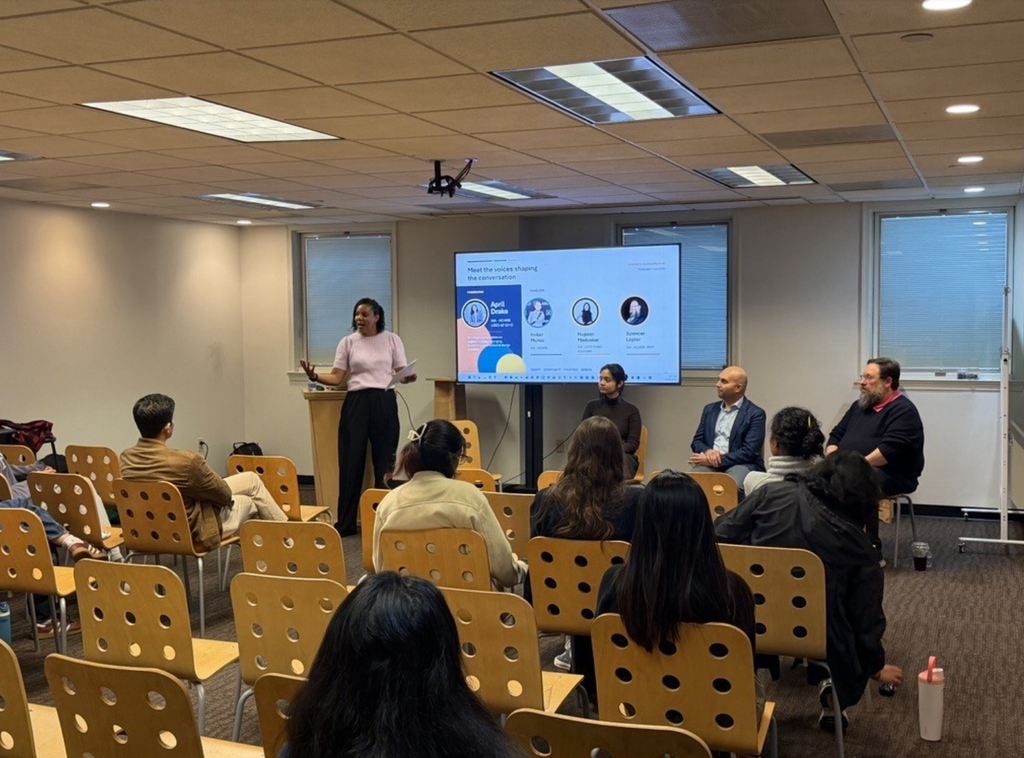
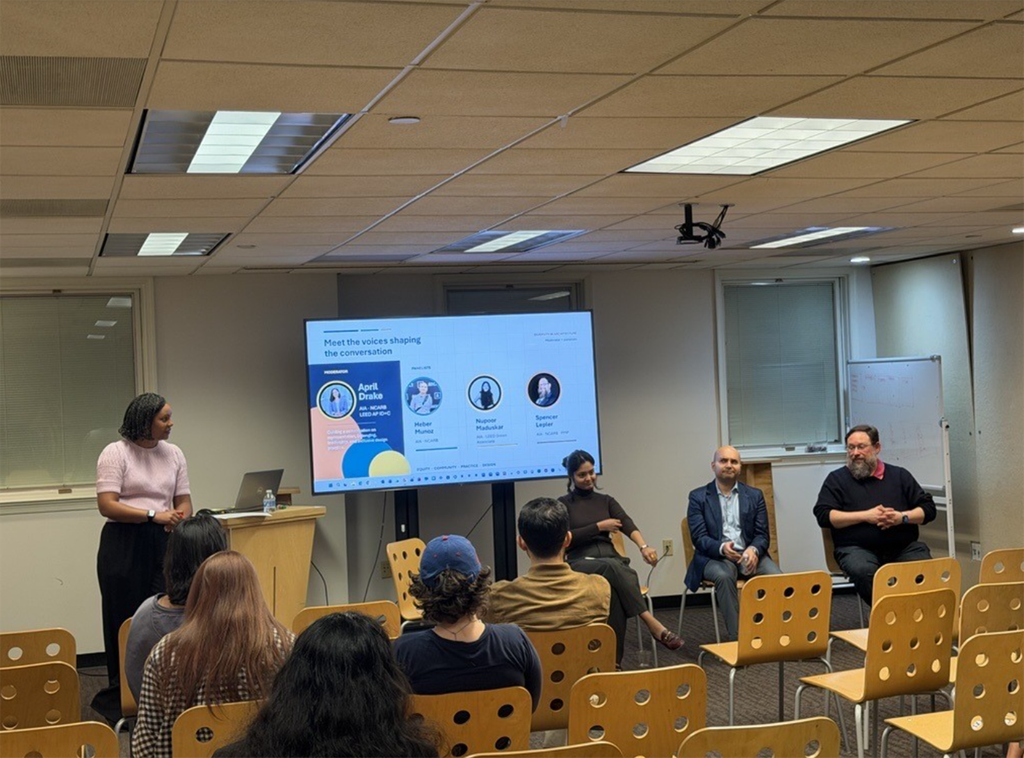
AIA Northern Virginia’s School Connections Committee and LGBTQIA+ Committee came together to host a panel discussion for students at the Washington Alexandria Architecture Center (WAAC) as well as members of the Architecture community. The panel focused on diversity, equity, and inclusion in architecture and the important role representation plays in shaping both the profession and the communities architects serve.
The purpose of the event was to create an open conversation around the many dimensions of diversity within architecture—including race, gender, culture, socioeconomic background, ability, and lived experience—and to consider how those perspectives influence design outcomes, workplace culture, community engagement, and access to the profession.
THE CONVERSATION
The discussion was moderated by April Drake, AIA, NCARB, LEED AP ID+C, who guided a thoughtful conversation with panelists Heber Munoz, AIA, NCARB; Nupoor Maduskar, AIA, LEED Green Associate; and Spencer Lepler, AIA, NCARB, PMP.
Drawing from their own professional and lived experiences, the panelists reflected on the ways diversity and representation within architecture have evolved during the course of their careers, as well as the challenges that remain. The conversation explored barriers that can affect access, advancement, and retention within the profession and considered how architects, firms, mentors, and industry leaders can help create more equitable pathways and opportunities.
Nupoor shared her experience entering the profession as an international student and the additional barriers that came with needing employment-based visa support. She described facing repeated rejections and the difficulty of finding employers willing and able to support international employees through the visa process. Her experience highlighted how something as fundamental as where a person was born can shape access to professional opportunities, requiring some individuals to work significantly harder than their peers simply to reach the same starting point.
The conversation also explored the personal toll that can come with navigating cultural differences and the pressure to assimilate. Heber reflected on coming to the United States from El Salvador at a young age and being told to “keep his head down”—advice rooted in the idea that success meant working hard, not drawing attention to himself, and doing what was necessary to fit in. As a young immigrant, that message shaped how he learned to navigate spaces where being perceived as different could feel like a barrier to opportunity. He spoke about the pressure to work harder, prove himself, and avoid being seen as “other” in order to access the same opportunities as those around him. Heber’s experience highlighted the tension between adapting in order to succeed and maintaining a connection to the identity, culture, and experiences that shape one’s sense of self.
This raised a broader question about what inclusion in the profession truly means. Access to opportunity is important, but so is the ability to pursue that opportunity without feeling that acceptance depends on concealing, minimizing, or distancing oneself from parts of one’s identity. Creating a more equitable profession therefore requires looking not only at who is given opportunities, but also at the different levels of effort, uncertainty, and personal compromise that may be required of people to access them.
Through sharing his experience, Spencer also acknowledged that diversity is not always visible. Disabilities, identities, backgrounds, and other aspects of lived experience may not be immediately apparent, and individuals may make intentional choices about what parts of themselves they share, when they share them, and with whom.
April noted several ways people may navigate disclosure in professional settings, including deciding how much of their identity to share based on their comfort, sense of safety, and how they wish to be perceived.
That consideration can begin as early as the interview process. When it feels safe to do so, sharing aspects of one’s identity or lived experience can offer another way to understand a prospective employer—providing insight into how an organization responds to differences and helping candidates assess its culture, inclusiveness, and sense of psychological safety. At the same time, the conversation reinforced that disclosure is a personal choice, and individuals should be able to determine what they share without feeling pressure to reveal parts of themselves they would prefer to keep private.
The discussion also looked beyond representation alone, considering how the diversity of a project team can influence the design process itself—from the questions designers ask and the assumptions they challenge to the ways they engage with clients and communities.
Topics explored during the conversation included how diverse perspectives can strengthen design processes and project outcomes; barriers to entering, advancing, and remaining in the architecture profession; the additional challenges faced by international students and professionals navigating employment and visa requirements; the importance of inclusive workplace cultures, mentorship, and leadership opportunities; equitable approaches to community engagement; and how lived experience can shape the way architects understand and respond to the people who ultimately use the spaces they design.
TAKEAWAYS
One of the central themes of the discussion was that diversity and design excellence are interconnected. Bringing a broader range of perspectives and lived experiences into the profession can help architects challenge assumptions, better understand the communities they serve, and create more thoughtful and responsive built environments.
Participants also gained a deeper understanding of the barriers that can affect access, advancement, and retention within architecture. Those barriers are not experienced equally. For international students and professionals, for example, access to employment may depend not only on talent, education, and perseverance, but also on finding an employer willing to navigate visa requirements and provide the necessary support. The result can be a professional journey marked by more rejections, fewer available opportunities, and the expectation that one must continually work harder to earn access to opportunities others may be able to pursue more freely.
The discussion also challenged attendees to consider the less visible costs of that unequal effort. When success seems to depend on fitting in, avoiding being perceived as different, or continually proving one’s value, people may feel pressure to make themselves smaller or leave pieces of themselves outside the workplace. A truly inclusive profession should aspire to more than opening the door; it should create an environment in which people do not have to abandon parts of themselves in order to walk through it.
Ultimately, the panel encouraged attendees to think about inclusion not simply as a professional initiative or a question of who is represented, but as an important part of how architects collaborate, engage with communities, and approach the responsibility of designing for people with experiences and needs different from their own. Inclusion is not only about who is present or who is given an opportunity; it is also about whether people feel safe, supported, and able to bring their full selves to the profession once they are in the room.
THANK YOU
We extend our sincerest gratitude to our moderator, April and our panelists, Heber, Nupoor, and Spencer for sharing their experiences, perspectives, and insights and for contributing to an open and meaningful conversation about diversity and representation within architecture.
A special thank you as well to everyone who attended, asked questions, and contributed to the discussion. An additional note of thanks to the members and volunteers of the AIA Northern Virginia School Connections Committee and LGBTQIA+ Committee who collaborated to organize the event.
We especially appreciate Heber Munoz Architecture for supporting this program and helping make the event possible.
Jessica M. Somgynari, AIA
AIA Northern Virginia School Connections Committee Co-Chair
Learn more about the LGBTQIA+ Alliance
Learn more about the SCC committee.
Published: 11/12/2026
Share This Article